If you can spare a few dollars, it would help a lot: PayPayl.me/Guard13007
It’s been about a year of subpar income with no benefits, keeping us alive but still in danger, and now that is gone entirely. :D

Miscellaneous Idea Storage
If you can spare a few dollars, it would help a lot: PayPayl.me/Guard13007
It’s been about a year of subpar income with no benefits, keeping us alive but still in danger, and now that is gone entirely. :D
I’m watching a video about Boom Supersonic and somehow I hadn’t previously recognized that their aspirational goal is environmental destruction through high fuel burn while only supporting travel for the rich. They explicitly state they want EVERYONE flying supersonic, but we know that isn’t going to happen. Thankfully, that does limit the impact somewhat, but I don’t think it does enough.
So I started reading their report on fuel consumption (PDF), which affirms what I already thought by stating they are only comparing fuel burn to “premium” fuel burn. Even when biasing things in their favor in this way, it’s 2-3x more fuel per seat. When comparing to the commercial average fuel use per seat, they use 5.3-7.9x more fuel.5
There is an apparent contradiction between their stated goal of overland supersonic flight and part of their fuel burn calculations including accounting for “Flight speed restrictions and routing to avoid sonic boom impacts over land masses, including secondary boom standoff distances”. I think it’s also interesting their study only includes oversea flight paths in its comparison. What happened to the whole point being that you can do overland flight? Maybe they’re just hedging their bets.
I would be remiss if I did not mention they proudly claim “Boom’s sustainability strategy centers on the use of 100% sustainable aviation fuel (SAF) and efforts to rapidly advance and scale SAF production.” Their goal relies entirely on something that doesn’t exist, but they admit it, that’s good.
The real problem is even if SAF exists, using it for a supersonic aircraft while other aircraft aren’t using SAF means burning more fossil fuel. When the fuel you use could’ve fueled flights for 5-8x more people instead, you aren’t actually carbon neutral, you’re offsetting carbon neutrality by using it up, rapidly.
I am also concerned the only specified source of SAF in this document is “using CO2 from the atmosphere and renewable electricity to produce near limitless zero carbon SAF”. That’s the most energy-intensive way to make a fuel, which makes it the most offsetting of clean energy possible. (It also doesn’t meet the definition of zero carbon.)
Again, it is important to note they claim to be funding climate science on the impacts of air travel, and trying to reduce non-CO2 impacts as well. I’m not writing this to say everything they do is wrong, but to highlight the ways in which it is misguided.
Boom achieved carbon neutrality in 2021, and has set itself an ambitious goal to be net zero carbon by 2025.1
I think I should put this quote alongside their decision to start burning tons of methane in 2025: Boom Supersonic to Power AI Data Centers with Superpower Natural Gas Turbines; Adds $300 Million in New Funding. This represents around 14 kilotons of CO2 put into the atmosphere per day, or 5 megatons per year. Nice.
By the way, did you know “carbon neutral” and “zero carbon” are actually different things? Carbon neutral is based on the idea of pulling as much carbon out of the atmosphere as you put in, while zero carbon is to claim putting NO carbon in at all – which is currently impossible.
It’s called Public Relations: Publish good news. Say nothing when there’s bad news. Boom Supersonic stopped published sustainability information in 2023. Their ambitious goal to be zero carbon by 2025 was announced in 2022, as far as I can tell. The document I’m reading is from December, 2022, but I found an article in May making the same claim.
Also I think it’s funny they show how jet engines used a lot more fuel than piston-powered aircraft initially, and then took half a century to use almost the same amount of fuel, implying the switch to supersonics will follow a similar trajectory, when there’s no reason to believe that can happen. Even if true, that would represent a large increase in aviation fuel use, offsetting or even reversing the progress towards clean energy.
This was originally written and posted on Bluesky, before being cleaned up, reformatted, extended with more information, and a couple minor errors corrected. Its working title was “Boom Supersonic’s goal is implicitly climate accelerationism”, but I thought a less aggressive title would reach more people.
Because they only compared to premium seating, I knew the actual fuel use difference between current aircraft and their proposal was higher, but I didn’t know how much higher. The wording used confused me and I misread it a few times. I won’t say it’s intentional, but I will say that comparing a proposed aircraft to flights that do not exist is misleading. Not even Emirates – with their gaudy gold-trimmed opulance – flies aircraft with only premium seating.
From the Executive Summary (emphasis mine): “This study finds that supersonic air travel on Overture consumes 2-3 times as much fuel per seat than comparable premium class subsonic travel, depending on the routes evaluated, as well as various fuel consumption assumptions related to the subsonic fleet.”
From Section 1 (emphasis mine): “Recently published studies claim that supersonic aircraft result in between 5-9 times3 as much fuel consumption per passenger than subsonic aircraft. However, these claims are based on non-comparable data which do not provide an accurate comparison of supersonic to subsonic aircraft.” You’ll notice they don’t explicitly say they disagree or found a different result, and instead rely on the implication, causing one to assume a difference was found. Technically, their results are different, but not meaningfully different.
In Section 2, the methodology is laid out: Fuel use is based on the ratio of passenger/cargo weight, modified by the cabin floor area dedicated to premium passengers, and divided amongst the seat count within. This is followed by the only specific fuel numbers presented: “Across all aircraft operations considered in this paper, the average subsonic fuel consumption intensity was found to be approximately 0.014 gallons per seat-mile (considering both economy class and premium class seats). The fuel consumption intensity for subsonic premium class seats was approximately three times larger than the average across all subsonic classes of travel, at 0.037 gallons per seat-mile.”
I was very confused why they said “approximately three times larger” when 0.037/0.014 is ≈2.64. I kept re-reading it, trying to find a charitable and consistent interpretation. I now realize they were just rounding aggressively, but I was so confused by this because their choice to round here makes their fuel use look worse. It implies a true fuel use of 6-9x more per seat, when it’s actually 5.3-7.9x more per seat. I thought I read it wrong, multiple times.
Updated 2026-09-06 to fix a formatting error.
I’ve been thinking about Click a lot recently, and how it’s a tragedy disguised as a comedy so effectively that it was critically hated, and I fear people not seeing what it truly is because it’s falsely labeled as a braindead comedy. Turns out, I’m not the only one recently thinking about this.
do the creators of click realize they made a tragedy annnd click Search
Of course the AI says, “Yes, they were aware they added tragic elements.” Every comedy has tragic elements. You can’t just make jokes and be funny and not have some contrast. But anyone who sees Click as a comedy is deluded or hasn’t watched it. To me, the most interesting detail around the film is how I’d only ever seen people dismiss is as Adam Sandler-shlock, an average dumb comedy. But that’s kind of the secret of it? You trick people who want braindead entertainment into watching something poignant.
[…] I think it’s maybe the saddest film ever made. The idea of life hurtling past you at unstoppable speed, directly towards death, all because of a broken TV remote, is absolutely horrifying to me.
The writers try to wrap it all up in a happy ending in a couple of minutes, so you’re forgiven if only the bleakness stuck with you. 1
The marketing and public perception of the movie seemed so disconnected to me it made me wonder if the team behind this movie even knew they created a tragedy. In retrospect, it was silly to doubt their competence when it was so well crafted. I learned Adam Sandler’s father died shortly before production, and the director got him to cry by reminding him that his mother misses her husband every night… yeah, they knew exactly what they were doing.
If you want to know more about the background of making Click, read An oral history of Adam Sandler’s Click: Alternate ending, Paul Thomas Anderson’s note and more (exclusive) by Josh Weiss on MSN, it goes very in-depth. (And holy crap, I did not realize that was only published two days ago! I just had the thought to look into this movie a little more, and what timing.) The only real failure of that article is saying that the character Michael is a good person. He is awful, beginning to end, only recognizing it at the very end.
I had no idea it started as a drama, and how it’s supposed to pay tribute to It’s a Wonderful Life. It’s also absurd to learn that Sony wanted their logo on the remote – imagine forever associating their brand with existential dread! The original ending had Michael dying, then in his house, he thinks he has a second chance, and it’s a gut-punch that he’s in Heaven.
Maybe my perception of how the movie was viewed is mostly due to poisoning the well from critics hating low brow humor and the way they were misled, as well as thinking a comedy actor can’t deliver drama.2 Audiences liked it okay, and it made a bunch of money, so it was successful.. even if it’s not really remembered.
Ultimately, I think I’m correct that the point of its presentation is to trick you into engaging and having an emotional reaction. People saying it’s the only movie that made them cry is my evidence for this, as how could it be the only movie unless you avoid emotional movies? The trick worked.3
Click: The Worst Movie ⏐ Big Joel by Big Joel
I like the movie’s message, and it did make me cry, because I was too naive to realize how hateful so much of it is. I still value the message, but it was delivered poorly for a mature person. I felt like it was important to include this video because it highlights a good chunk of what’s wrong with it.
The most obvious failure of Michael immediately upon getting the remote is fast-forwarding instead of pausing for more time. Skipping will always cause problems, but pausing to consider can make things work so much better. (It’s kind of a minor failure though, as it would ruin the whole point of the movie.)
(This was originally written 2026-06-25.)
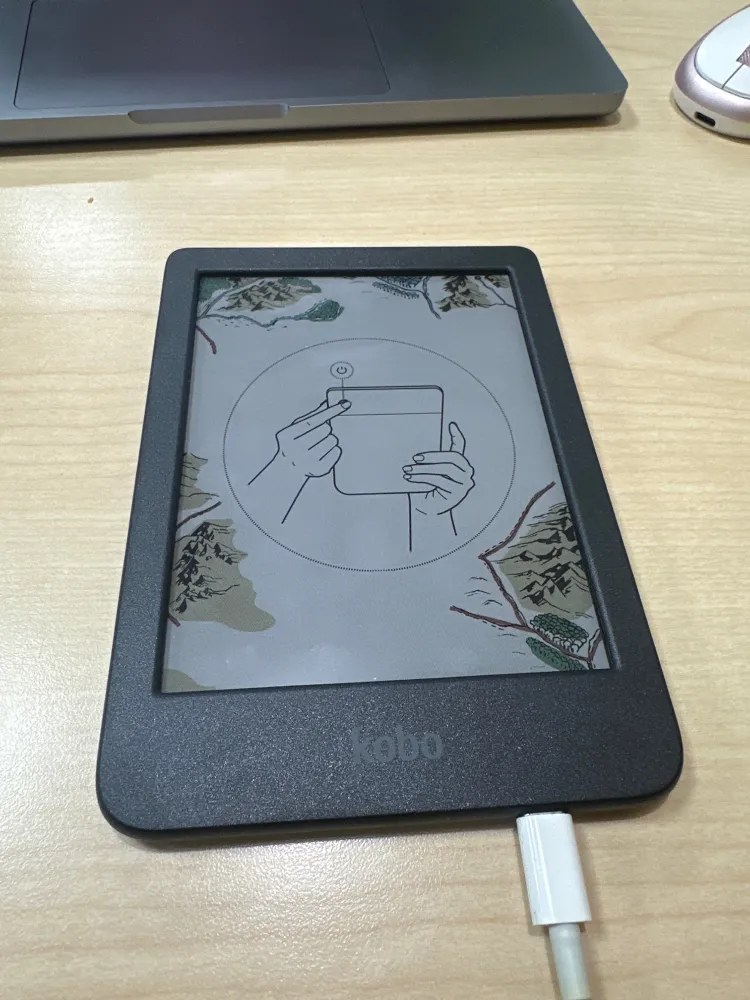
Reading is important to me. Half a year ago, I tried to use a Nook GlowLight 4. The result of that is documented in Do not buy a Nook GlowLight 4. As you can guess by the title of this piece, I had a similar experience today. Since I wrote that piece, Kobo devices became available in Best Buy locations, and someone told me I was wrong about them requiring an account to use1. Their confidence in the face of so much obvious information to the contrary convinced me to try it for myself. (Note: Each of those words is a different link.)
The first warning sign was in the difference between the quick-start guide’s instruction and how the device actually works. It informs you to press and hold the power button to turn it on, but that does not work. You must press and hold briefly for it to power on (it will not turn on until you let go), and it automatically turns on when plugged in2. It then tells you to go online to get started, with no indication in the guide or on-screen that you will be forced to make or sign into an account, or that you can set up the device by connecting it to a computer.
A point in its favor is that the device recognizes a captive portal and allows you to access the browser to get online before registration. Once I was online, I was presented with an account type selection screen with around 30 options. I knew to expect this, despite their insistence that everyone else is wrong, so I went to look at options for bypassing it.
The first thing I found was an article praising Kobo’s new sideloading mode3 – a way to use the device without an account at all. Of course, you have to know this exists and be comfortable going into hidden directories and editing an INI-formatted file4, and know that you can plug in the device to do this. None of this is presented in a user guide anywhere I could find (and believe me, I spent multiple days looking). Even in the multiple online guides I found, no one explains that the device must be restarted for these config changes to take effect. I couldn’t even find the firmware version to check whether or not I have access to this feature. (And when I did find it, it wasn’t labeled as firmware version, you’re just supposed to know that “software version” really means firmware version.)
A problem many technically minded people have is not being able to understand that the vast majority of people do not know and are not interested in learning how to work with computers beyond a surface level. A setting this buried is effectively not an option at all. When determining the quality or value of a device, the majority’s ability to use it matters more than how well a technically-minded person can use it. I’m glad to see people learn to do more with their devices, but it shouldn’t be from secrets to be discovered like this.
I was working with a terrible internet connection, so I decided to charge the device while finding information. I turned off the device and plugged it into my computer. The screen entered a broken state where it displayed the prompt5 asking if I want it connected to the computer while powered off. There is a black screen that is used when the device is off, but the prompt was displayed on top of that. This concerns me greatly, because it shouldn’t be possible for the “connect to computer” state to interrupt powering down, especially after the point where the screen actually switches to its off display.
Trying to restart the device after it entered this broken state led to a screen with a crossed-out power button and three dots, animating them filling and unfilling. Some kind of loading screen? I now know this is what the device looks like while factory resetting, but at the time I did not, and a crossed-out power button can just as easily mean “I don’t have enough power” as it could mean “don’t turn me off”. The device was stuck in this state for a long time, long enough that I assumed it was broken and tried to force restart it. Then it cleared the screen to a black white of nothing, and refused to do anything.
I went through a series of attempts to bring it back, plugging it in, unplugging it, trying to turn it on while plugged in, trying to turn it on while not plugged in. I don’t remember how many times I tried this, or which state actually brought it back, but somehow it returned to the default screen it had when I pulled it out of the box. This is when I discovered the power-on instructions are wrong. Earlier, I had been a bit impatient and let go of the button quickly – which you’re supposed to do but the instructions tell you to hold it down. I again assumed the device was bricked, because it would not respond.. and then it turned on after I gave up.
When it went to the screen that had previously recognized it was plugged into a computer, it did not prompt me to connect, so I unplugged it and plugged it in again. (This became a step I had to repeat many times throughout testing the device.) I followed a simple guide6 to bypass the requirement, and finally had a functional device.
Correctly, the device showed no books.. but when sorting by author, suddenly there was like 40 authors, each with a single entry. Tapping on any one of them brought up the “no books” page, but modified to go back to an author list. It was the same for the tab to sort by series, except there was also artwork for all of these supposed book series. There is no way to remove these, and I could not find anyone even acknowledging this problem exists. (The weirdest part to me was how throughout the rest of my testing, these did briefly disappear, but then never stayed away.)
Another problem I have with this device and basically every option that exists similar to it is rampant advertising. They don’t call it advertising, but that’s the purpose it serves7. The home page presents you with mostly options to go to Kobo’s store, rather than access your books ..you know, the entire point of having the device, to read your books? Now, combine that with fake entries in authors and series to clutter things… I just hate it.. no, I despise it.
I started downloading the latest firmware version and tried activating sideloading mode. It worked, eliminating all of the advertising and junk fake book data. I was extremely excited. I tried out the browser and found it worked well enough – though I couldn’t access my ebooks server directly, but what really amazed me was the responsiveness of the screen. There’s a little sketching utility that worked really well, and I could type on the keyboard without too much difficulty (though a lot of error due my unfamiliarity with it).
I opened a book (Martha Wells’ Platform Decay if you’re curious), and immediately ran into.. this ebook reader.. does not.. support.. EPUBs correctly. The epub format is the most popular and accessible ebook format. Amazon briefly tried to dominate with their own specific format, but freely available formats tend to work better long-term, and thankfully that won out… but that makes it even more baffling that this brand new eReader couldn’t recognize the table of contents for a brand new ebook. How do you make an eReader and make it fail to read a table of contents?
Maybe it’s a firmware problem? I have a bunch of other stuff to check before the download finishes on the latest version. (Spoiler: No.) I decided to load a PDF from an Internet Archive scanned book, and that was quite the sad experience. It takes 3-4 seconds to turn a page. (For comparison, The Nook I tried did it in like 1 second.) Worse, I know this isn’t a hardware problem or a flaw with the PDF I chose to test with, but bad software.
After a firmware update8, PDFs take closer to 3 seconds on average to turn a page, and now there’s a Bluetooth indicator in the title bar9. (This is how I learned what a factory reset looks like, because they use a very similar design for applying updates. I’m leaving out details like how often I reset the device, partially cause it was exhausting and I don’t remember, and partially cause this is already too long.)
At this point, I knew the device wasn’t really going to be usable for me, so I figured I should try third-party eReader software on it to see how that compares to the stock experience.
The most noticeable difference with these was how much smoother things ran. I wanted to test more with regards to PDF handling (different formats, high-res large images, a long and detail anatomy textbook) and compare the different eReader software options. I also intended to check out how well it could display comics, and try an audiobook since this device with no audio port is supposed to be able to play them.
I don’t remember how many times I opened books or rebooted the device, but it worked stably, until it didn’t. It suddenly factory reset, and displayed the original screen again. When turning it on, it resets again. An infinite loop.
SideloadedMode?I wrote most of this piece in one night, and then came back to check details, add links, and make sure I didn’t get things wrong in my rush to turn hours of notes into something readable. I wanted to link to Kobo’s release notes and the announcement of sideloading, but I can’t find anything from Kobo about it. There is a forum thread apparently containing the release notes, but this contains no reference to a source. There are many articles praising the decision to add this feature, but none of them reference Kobo – it all comes from forum users. This poorly worded article even calls it an unveiling.. but I can’t find anything except the veil.
The only official reference to the device sideload mode I could find from Kobo is in a 2024 blog post where they say they updated parental controls to block sideloading. I tried contacting them and received no response12. (I do find it funny that in their recent partnership with Storygraph, they explicitly block you from automatically syncing your own books – what they refer to as “sideloaded” books.)
I point this out because it’s part of the whole problem with all of this. There are options to make these devices better, but you just have to know they exist. No official source will tell you about them (except for hinting at it in that one blog post).
I don’t have anything to add about accessibility myself, but I would like to share a video I watched in January or February about Kobo’s accessibility:
This blog post was written in early January, 2026, and updated just before publication to correct errors and add details, mostly through footnotes. The tl;dr is that I was misled into believing a Nook would be viable eReader, but there don’t seem to be any viable eReaders anymore.
I’ve been using Google Play Books to read ebooks for years, because I haven’t found another ebook reader that uses actual pages instead of an infinite scrolling interface1. I rely on the feel of pages to help me be comfortable with stopping at specific points that aren’t chapter or scene breaks, especially in books with very long sections. For a few months, this has happened on an Amazon-branded tablet – which, to be clear, was only because it was lightweight, laying around after being given away, and could be hacked to remove a lot of Amazon’s spyware and control2.
That said, I never completely eliminated Amazon’s crapware from it, and it was dropped a few times, leading to the state of sprinkling glass dust around and being slightly difficult to read now. And it’s a tablet capable of playing videos using Grayjay and browsing the web. This is nearly unacceptable, because I refuse to lock the device due to wanting quick and easy access to my books, but it’s insecure. I have accounts on it disconnected from most of my things, but not ALL of my things. It’s dangerous.
It’s also distracting. I mentioned videos and web access because I spend more time on it watching videos than reading books. That’s not what it’s for. So I started looking up eReaders, knowing that I should be able to afford a very cheap and maximally incapable device so that it can truly be only for ebooks. Amazon is right out because they do not allow buying ebooks anymore3, 4, and they even completely blocked downloading ebooks in February 2025. (Their propaganda is so effective I believed it had been temporarily suspended in 2026.)
Critically, the experience of checking out a library ebook is functionally identical to downloading a copy from Amazon.
– VP of Grand Central Publishing (an imprint of Hachette) in the Internet Archive Controlled Digital Lending litigation5
Amazon also designs all their devices to constantly advertise to you and collect information about you6. It’s spyware and adware they make you pay for. To some extent, this is always unavoidable, but you can at least avoid giving more power to the largest reduction in author income7, 8, 9, 10.
The only other options seem to be Kobo and Barnes & Noble’s Nooks. I’ve used a secondhand Nook many years back, and it was perfect for the brief period of time I had it. Long-lasting battery, fast enough, only does books, and no distractions. I really appreciate e-ink displays as well for their low power consumption and encouragement to do tasks with little screen activity – like reading. That said, I try to research things before making choices, so I spent time comparing options.
Kobo devices can only be obtained through shipping or Walmart11, and there are many reasons to avoid giving them any more power. They’re also wholly unfamiliar to me, and while looking up info online revealed a lot of info on how to hack them. Ideally, I’d use a device that just works instead of one I have to fix before I can use it. (I also stumbled across their parent company being claimed to be Japan’s Amazon12 in terms of invasions of privacy13, 14 and criminal malfeasance15, so I don’t exactly like that.) Oh, and they have browsers18 and extra features that can distract, when the whole reason I want an eReader is to have something that does nothing except read books.
I made a video reviewing my Kobo e-reader from an accessibility POV and I had to cut a whole tangent about their AI help bot as it ran too long but it’s my view they are an accessibility nightmare due to the cognitive load required to get what you want. Their one goal is to make you give up.
– Philip @disabledphil.bsky.social
Nooks have physical buttons, which make reading with them easier, and do nothing except access Barnes & Noble’s store and read books. They also don’t require any special hacks to put your books on them. Perfect fit? That’s what I thought.
After obtaining the device, the first hurdle was requiring an account and to be online to set up the device. This is nearly unacceptable, but a small price to pay when you never need to connect again to use it. I decided to ignore the yellow flag and continue. It immediately wanted to update, but as I only had the power available on the device from factory (somewhere under 30% – and you shouldn’t trust a brand new battery meter immediately either), I skipped this. It was also near closing time for the Barnes & Noble I was at, and I wanted to make sure it was usable before leaving.
I downloaded a few books from their free collections, and headed home. At home, I started copying my books onto it and charging the device. I found that most of my in-progress ebooks loaded fine, but two had errors I needed to fix with calibre. A couple of them loaded a little slow, but this didn’t seem too bad to me. I decided to try the shelves feature and organized the 79 books I’d imported and jumped to where I was in them. The second yellow flag was that the page numbers didn’t match. Some books were suddenly longer, some shorter.
I’d read that Nooks support archiving your books through their cloud service to keep track of where you are in books, annotations and highlights, and so you can free space on your device when needed (this is misleading claim, as all of these features are locked behind purchasing said books through their store, but this is not highlighted). I bought their 32 GB device so I’d have a long time before needing this, but it’s still nice to free up space when you can, so part of my loading of ebooks was loading a couple that I’d finished so that I can archive them and mark them as read. It turns out, not only can you not archive your own books, but you can’t even delete them. (I organize my ebooks through a web interface based on calibre, so I was fine deleting them.)
At this point, the battery had charged enough I was comfortable updating the device, so I went looking for how to do that. Not only is there no obvious way of doing this, but official instructions online all point to options that do not exist on the device. I figured maybe the online copies had all been updated and the stock version doesn’t have the option until it updates, which sucks, but I can deal with it once it figures out to update itself.
I continued copying in books and fixing a few more errors with my own files, until it decided on its own after a reboot to update. This update deleted my shelves and book progress. That’s a red flag for me, but I’ve been told I’m a bit too quick to judge, so I decided to push past this and try to use the product anyhow. I recreated a test shelf – unwilling to waste time organizing when I felt sure the organization would be deleted again.
I again looked for how to check for updates, and the instructions still don’t match, even though there are minor changes on the device after the update. Then, after another reboot, it automatically updated again. Automatic updates that don’t update to the latest version are another yellow flag for me. It indicates someone didn’t make the update progress reliable and consistent. (It’s not quite a yellow flag to me for updates to appear and start applying without warning, but it very nearly is one, because that’s incredibly rude and does not care for what you’re doing, or how urgently you may need to access something on a device. Imagine your phone decided to apply an update while you’re trying to pull up your medical information in an ER. That delay could kill you.)
Again, my test shelf was deleted. At this point, I discovered my book progress at least was not actually deleted, but simply hidden until I opened a book again. This is not exactly a yellow flag, but still strange behavior – the data is unchanged, so why did the interface change to show every book as never opened until I open it again? It does not instill confidence when a device randomly hides and changes important user information like this.
At some point during all this, I’d noticed that the device was only showing 5 GB available when it should be approximately 27-29 GB available depending on exactly how much Barnes & Noble rounded the listed specs and how much space the operating system uses, and I’d been looking at other users troubleshooting various issues while trying to find out how to update the device manually. I stumbled across people losing their entire libraries or all annotations and highlights after updates. This is nearly a red flag. Fluke issues just happen sometimes, but I’d already been experiencing multiple data loss events here, and saw evidence I would encounter more over time.
We’re on update 2, right? I lost my place because so much shit happened. I finally found how to check for updates, which is hidden under “About” in the settings (which is not stated in the manual or online anywhere I could find – they say it’s under a different label, though I cannot remember what right now). This update system also updates 3 components separately, the reader, the store, and the “platform” (which I assume is the actual operating system). And surprise, it needs to update again. When I checked, there were no updates available, but after another reboot as part of troubleshooting the other issues I experienced, it decided to update a 3rd time!
This 3rd update didn’t delete the test shelves I’d remade, so progress? But I was already feeling kind of sick of all this crap so I treated this suspiciously instead of as a win. I’d been noticing slower loading times after the 2nd update, and occasional complete lack of response to input, but sometimes I’m too gentle, so I gave this a pass for now – I might’ve accidentally touched the bezel or missed a button after all, it’s a small screen!
At this point, if I could replace this device with a factory update version and never go online with it or otherwise disable updates, it would still be acceptable. I’d have an efficient eReader that handles my books, and I already manage them elsewhere. The page numbering being wrong is annoying, but ultimately, I care more about reading than getting those details perfect. But you cannot set the device up without a connection and account, and it automatically downloads updates to decide when to install them later. This would still potentially be acceptable if I could make that initial connection fast enough to interrupt the download.. but there’s another problem – Barnes & Noble advertises that they made a deal with AT&T to make these devices automatically connect to any of their hotspots automatically, and it also automatically recognizes and connected to any Barnes & Noble WiFi. As a result, I’d be essentially walking around with a hand grenade ready to go off any time. If I ever accidentally enabled the wifi and happened to be near AT&T infrastructure or a Barnes & Noble, I’d instantly lose my organization and have a device that works significantly worse. No thank you. I’m not living with that threat. And who knows? Maybe they have a timeout where if you don’t connect to the internet for a long time, it logs you out and forces you to set it up online again? I’m not taking that risk.
But honestly, that was something I only thought of after finding the final red flag. I was still willing to put up with this worse performance until I discovered why it kept saying it had significantly less storage space than I paid for. Barnes & Noble decided to limit your book storage to 5 GB on all of their devices. Their store can use all of the space, but your books are only allowed a small fraction of the device. This eliminates the majority of the point of buying the device for me, and especially the point of buying the slightly more expensive version with more space on it.
I refuse to accept this level of assholery and bad design for an ebook reader.
I want to read “Agency Pricing and Bargaining: Evidence from the E-Book Market” by Babur De los Santos et. al, which is updated every so often, apparently, since I’ve found a 2021 and 2025 version. But that’s near 50 pages long, and I’m tired. So consider it further suggested reading, I guess. It’s about how pricing changes depending on negotiating positions and types of negotiations.
I was initially concerned about the use of footnotes within footnotes making it appear like I’m trying to inflate my reference count, but it really disrupted the flow of reading one of the footnotes to NOT have separate footnotes linked like that. So fuck it, if someone wants to claim I’m artificially inflating it, fight me. I referenced the things I intended to, for the reasons I wanted. If I really wanted to inflate it, I would’ve copied a bunch of them from the NYU School of Law article5.
2026-07-25: Updated to remove WordPress’s broken “Read More” link.
2026-08-16: Typo fixed, 18th footnote. And then edited again to correct the footnote cause I learned more immediately after writing it.
2026-08-18: A parenthetical was encased in parenthesis, as it should be.
Yesterday, Louis Rossmann published a video about WeRecoverData, who threatened him with a lawsuit for publishing verifiable statements about their service. One of the issues he highlighted are fake business locations, where a business substitutes an actual operation with a drop off location using a third-party, but it is presented as a service location on Google Maps.
I decided to see if there are any videos of the Denver location. There aren’t. So I went there to see if it is a virtual office. After getting home, I decided to call them. Interestingly, I called after business hours, but they answered anyhow.
They stated phone data recovery prices range from $300 – $2,500, while HDD/SSD data recovery is $500 – $5,000.
In his video, Louis also highlighted how WeRecoverData claims not to publish success rates, but their website has a claimed success rate on every page. Today, he published a follow-up about how WeRecoverData has wiped the Internet Archive’s copies of its website and blocked them from archiving them in the future.
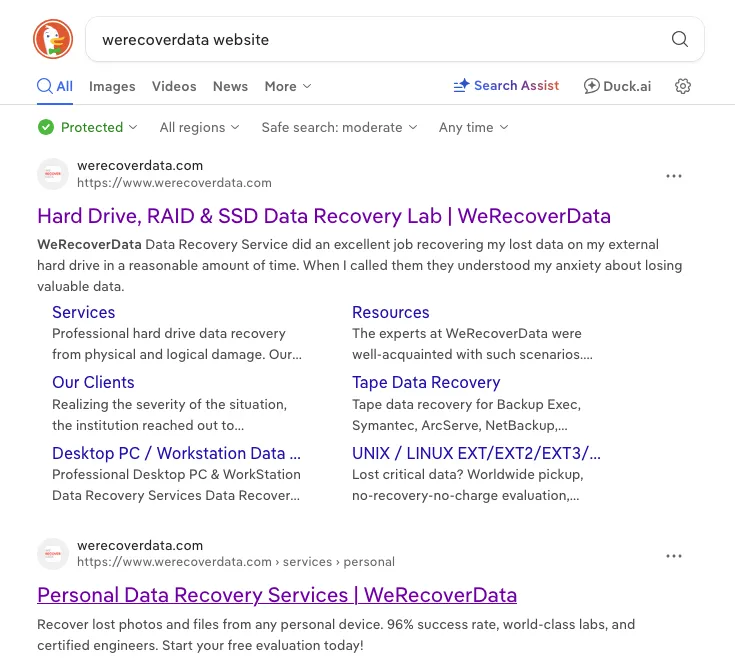
I checked just now, and they’ve removed that claim from their website. As you can see here, DuckDuckGo hasn’t yet updated its description to reflect the change, providing yet more clear evidence that this claim was factual when it was made.