I think the answer entirely depends on whether you think unfettered capitalism is suspicious, or if a company should put effort into maintaining good customer relations as well. Tesla has not violated any rules (in regards to the suspension recall / service bulletin only) as far as I can tell, but has made choices to protect their profit rather than taking responsibility for issues.
This is of course, separate from but related to Elon Musk’s support of the fascist takeover of the USA, and dismantling of federal protections and safety enforcement1. Considering Tesla vehicles kill twice as many people as the average vehicle2, that’s an understandable incentive.
I started with a vague memory of hearing something about Tesla having tires recalled in China, but dodging the same recall in the USA because of lower safety standards3. I found out about a very recent TPMS recall in the USA4 and a massive recall in China over regenerative braking modes being unselectable5, but the thing that stood out to me was China’s recall of nearly 50,000 vehicles due to suspension issues in 20206. My memory was either false, based on misinformation, or based on a misunderstanding of the TPMS issue as it was relayed to me7.
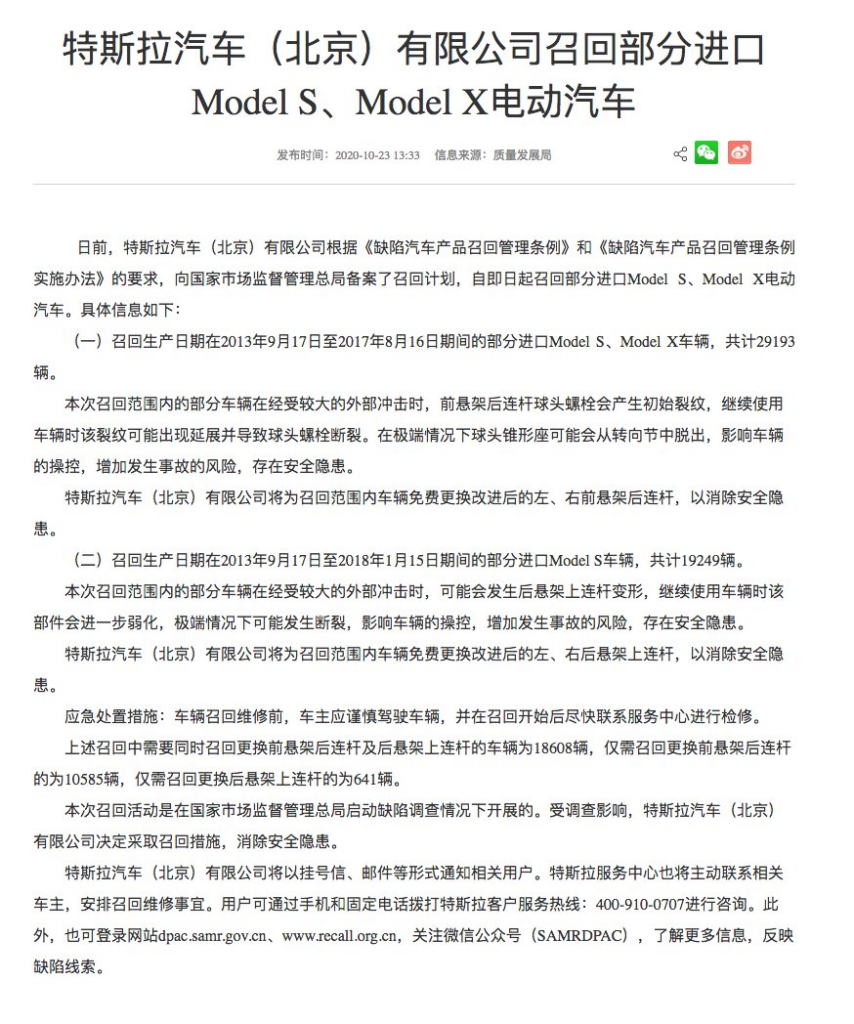
Tesla to replace connecting rods free of charge. 8
Chinese Teslas have the same suspension as American Teslas, so why is there no recall here? Apparently, in 2016, there were already enough complaints about this to encourage Tesla to put out a blog post addressing the controversy9. They state there are no problems with Model S/X suspensions and the NHTSA is not investigating them. To me, the most suspicious part of this post is their statements about making a customer sign a “Goodwill Agreement” to have repairs covered for free or reduced price, and that they claim this to be a normal part of the automotive business. It’s not.
It turns out that in addition to asking a customer to sign an NDA for 50% of the price of repairs, this may have been part of a service bulletin Tesla posted a year prior (which has been since deleted)10. This is an issue because manufacturers are not required to pay for repairs in service bulletins (unless the customer notices during a relevant warranty period), nor are they required to notify consumers. Service bulletins are not supposed to be used for things that can affect vehicle safety, but manufacturers have dodged responsibility this way before.
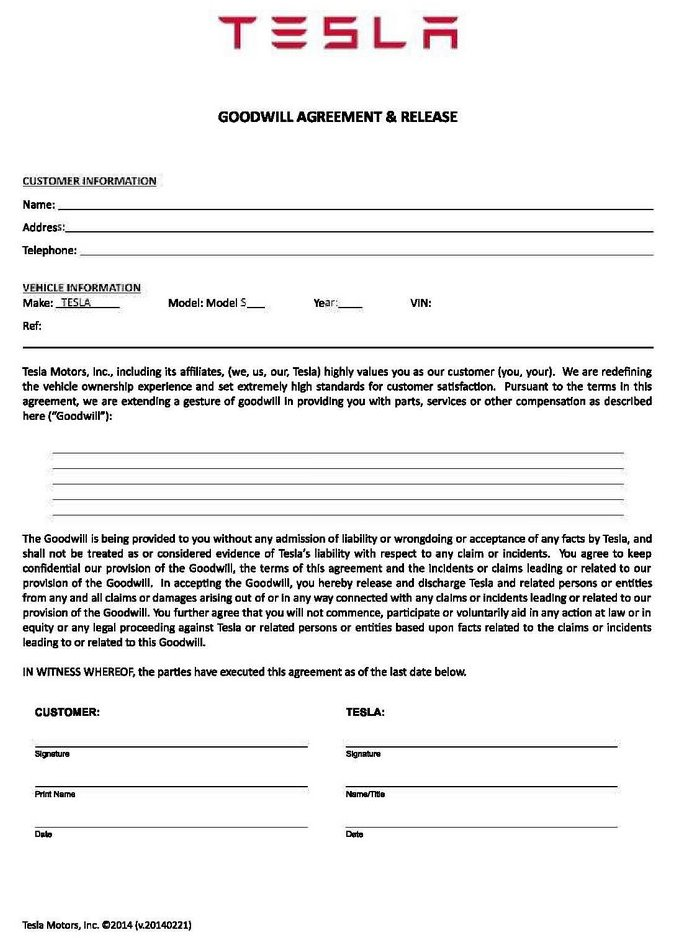
Tesla denied the NHTSA’s investigation (perhaps because they said “examining” and did not open a formal investigation at the time), and denied restricting customers’ ability to report to the NHTSA, even though the text of the agreement specifically requires confidentiality and denial of participation in legal proceeding. Aside from their pontificating about safety (despite having 2x the fatality rate of the national average2, and having deleted previous claims of safety), they call out an individual by name and claim he both fabricated the evidence and is responsible for a tracker of how long it would be until someone died in a Tesla, but that’s not true11.
I think it’s important to highlight that a large auto manufacturer stating an individual’s name while disparaging his publication of their shady business practices is exactly the kind of thing that leads to doxxing and death threats (or worse), especially when there is a cult of personality around its CEO. This is dangerous and unacceptable behavior when presenting to a large audience. There’s no way Tesla’s leadership doesn’t know that. In fact, I’d argue it’s the point – to stoke fear of presenting evidence.
NHTSA is examining the potential suspension issue on the Tesla Model S, and is seeking additional information from vehicle owners and the company.
NHTSA learned of Tesla’s troublesome nondisclosure agreement last month. The agency immediately informed Tesla that any language implying that consumers should not contact the agency regarding safety concerns is unacceptable, and NHTSA expects Tesla to eliminate any such language. Tesla representatives told NHTSA that it was not their intention to dissuade consumers from contacting the agency. NHTSA always encourages vehicle owners concerned about potential safety defects to contact the agency by filing a vehicle safety complaint at SaferCar.gov.
– NHTSA Communications Director Brian Thomas 10
The behavior is even stranger, as the blog post ends with not-quite-accusations of market manipulation and accusations of targeted fraud. Elon Musk tweeted, “Of greater concern: 37 of 40 suspension complaints to NHTSA were fraudulent, i.e. false location or vehicle identification numbers were used”12 and this was appended to the blog post as an “update”. However, he does actually appear to be correct about this not being a safety issue13.
Back to the suspension recall. Tesla is required to notify the NHTSA when a recall is issued in a foreign country to help prevent repeats of Ford’s irresponsible behavior killing hundreds of people in the 1990’s14. In their letter, Tesla blames Chinese drivers (which seems to be their default strategy15):
Tesla has not determined that a defect exists in either the Front Suspension Aft Link or the Rear Suspension Upper Link and believes the root cause of the issue is driver abuse, including that driver usage and expectation for damageability is uniquely severe in the China market. 16
This may be the core argument for why Tesla did not issue a recall in the USA. Tesla doesn’t want the liability. They previously issued a service bulletin for the same issue in the USA17, but it only specified a quarter of affected vehicles13. Tesla claimed extremely low actual failure rates:
The occurrence of such failures in China (approx. 0.1%) and elsewhere (less than 0.05%) remains exceedingly rare […] 16
When the NHTSA did their investigation18, they found 426 of 74,918 vehicles had experienced failure (0.57%). This is 5x more than the number of failures China used to declare a recall19. This is where the difference in how recalls are done comes into play. China took damage occurring to a component that is safety-relevant as reason to recall20, while the USA only makes recalls when there is evidence of immediate danger.
I think major components of a vehicle wearing out this fast should be recall-worthy regardless of safety impact, especially when service bulletins – despite the name including a word that literally means public notice or announcement – do not require notifying affected people. Another critical difference is that recalls must be paid for by the manufacturer, while service bulletins only have that requirement while in warranty – and only if the owner knows about it.
Thankfully, they are at least correct in that this failure does not appear to present a major safety risk, as only one injury was caused by the affected vehicles failing13. The failures tend to occur at low speeds, reducing the likelihood of harm.
Verbosity of NHTSA’s definition of “document(s)”
I was comparing a 2014 GM recall21 to the preliminary investigation letter requiring Tesla to provide documents about suspension problems22, and I couldn’t help but notice the massive difference in how utterly dense the legalese used to define what a document is. Again, since Tesla has a history of misleading everyone, it made me curious if they are the reason for this difference, or if this difference is only in letters sent to Tesla – since they have had so many investigations and recalls.
“Document(s)” is used in the broadest sense of the word under Rule 34 of the Federal Rules of Civil Procedure, and includes all original written, printed, typed, recorded, or graphic matter whatsoever, however produced or reproduced, of every kind, nature, and description, and all non-identical copies of both sides thereof, including, but not limited to, papers, letters, memoranda, correspondence, electronic communications (existing in hard copy and/or in electronic storage), invoices, contracts, agreements, manuals, publications, photographs of all types, and all mechanical, magnetic, and electronic records or recordings of any kind. Any document, record, graph, chart, film or photograph originally produced in color must be provided in color. Furnish all documents whether verified by the manufacturer or not. If a document is not in the English language, provide both the original document and an English translation of the document. 21
I looked into the mentioned Rule 34 of the Federal Rules of Civil Procedure, which indicates a history of changes and attempts to circumvent required presentation by quibbling over what “document” means. Even the 2015 amendment may not always be specific enough, I’m guessing, which is why they include their own definition instead of relying on this.
Document: “Document(s)” is used in the broadest sense of the word and shall mean all original written, printed, typed, recorded, or graphic matter whatsoever, however produced or reproduced, of every kind, nature, and description, and all non-identical copies of both sides thereof, including, but not limited to, papers, letters, memoranda, correspondence, communications, electronic mail (e-mail) messages (existing in hard copy and/or in electronic storage), faxes, mailgrams, telegrams, cables, telex messages, notes, annotations, working papers, drafts, minutes, records, audio and video recordings, data, databases, other information bases, summaries, charts, tables, graphics, other visual displays, photographs, statements, interviews, opinions, reports, newspaper articles, studies, analyses, evaluations, interpretations, contracts, agreements, jottings, agendas, bulletins, notices, announcements, instructions, blueprints, drawings, as-builts, changes, manuals, publications, work schedules, journals, statistical data, desk, portable and computer calendars, appointment books, diaries, travel reports, lists, tabulations, computer printouts, data processing program libraries, data processing inputs and outputs, microfilms, microfiches, statements for services, resolutions, financial statements, governmental records, business records, personnel records, work orders, pleadings, discovery in any form, affidavits, motions, responses to discovery, all transcripts, administrative filings and all mechanical, magnetic, photographic and electronic records or recordings of any kind, including any storage media associated with computers, including, but not limited to, information on hard drives, floppy disks, backup tapes, and zip drives, electronic communications, including but not limited to, the Internet and shall include any drafts or revisions pertaining to any of the foregoing, all other things similar to any of the foregoing, however denominated by Tesla, any other data compilations from which information can be obtained, translated if necessary, into a usable form and any other documents. For purposes of this request, any document which contains any note, comment, addition, deletion, insertion, annotation, or otherwise comprises a non-identical copy of another document shall be treated as a separate document subject to production. In all cases where original and any non-identical copies are not available, “document(s)” also means any identical copies of the original and all non-identical copies thereof. Any document, record, graph, chart, film or photograph originally produced in color must be provided in color. Furnish all documents whether verified by Tesla or not. If a document is not in the English language, provide both the original document and an English translation of the document. 22
I can not answer whether or not this is influenced by Tesla. I have not been able to find anything discussing the change in wording, but I have compared several different NHTSA letters to try to determine when this change was made. INIM-PE11011-46062 (2011), INIM-PE15025-62339 (2015), INIM-PE16007-64338 (2016), INIM-PE18008-73938 (2018), INIS-PE20003-78174P1 (2020), and INIM-PE20016-82633P (2021) all use nearly the same definition, indicating it was used inconsistently in the past, though it seems more consistent more recently.
It seems more like it was a definition someone put together a long time ago to try to deal with all the drama over Rule 34, but it didn’t spread to wider usage until later, and it was just coincidence that I encountered a drastic difference while looking into this. I figured it was worth pointing out though, just to show how things can be inconsistent and not every signal is an indication of malice. I also think the journey to find out information can be just as interesting as the information itself, which is kind of the whole point of writing this.
I got curious about Tesla’s history of denying fault with issues their vehicles have, their history of recalls, and Elon’s rage against recalls being appropriately named after learning that Tesla has the worst safety record of any vehicle manufacturer that sells to the North American market. And this is the result of spending frankly too many hours looking at information related (and unrelated) to that.
Machine Translation of 2020 Chinese Tesla suspension recall screenshot
This may contain errors, but I at least know the numbers are correct based on the CNBC article6. (Warning: Due to WordPress not handling blockquotes correctly, the “blocks” editor failing to copy quotes correctly, and the WYSIWYG editor not displaying correctly, the following section may have errors.)
Tesla Motors (Beijing) Co., Ltd. recalls some imported Model S and Model X electric vehicles
Published: 2020-10-23 13:33
Source: Quality Development Bureau—
Tesla Motors (Beijing) Co., Ltd., in accordance with the Regulations on the Administration of Defective Automobile Product Recalls and the Implementation Measures for the Regulations on the Administration of Defective Automobile Product Recalls, has filed a recall plan with China’s State Administration for Market Regulation (SAMR). Effective immediately, the company is recalling certain imported Model S and Model X electric vehicles.
Details are as follows:
(1)
Certain imported Model S and Model X vehicles manufactured between September 17, 2013 and August 16, 2017 are being recalled, totaling 29,193 vehicles.
For some vehicles within the scope of this recall, after experiencing a relatively large external impact, the rear suspension fore link ball-joint bolts may develop initial cracks. Continued driving may cause the cracks to expand and eventually result in fracture of the ball-joint bolts. In extreme cases, the suspension link may detach from the steering knuckle, affecting vehicle handling, increasing the risk of an accident, and creating a safety hazard.
Tesla Motors (Beijing) Co., Ltd. will replace the improved left and right rear suspension fore links free of charge to eliminate the safety hazard.
(2)
Certain imported Model S vehicles manufactured between September 17, 2013 and January 15, 2018 are being recalled, totaling 19,249 vehicles.
For some vehicles within the scope of this recall, after experiencing a relatively large external impact, the rear suspension upper link may deform. Continued driving may further weaken the component, and in extreme cases it may fracture, affecting vehicle handling, increasing the risk of an accident, and creating a safety hazard.
Tesla Motors (Beijing) Co., Ltd. will replace the improved left and right rear suspension upper links free of charge to eliminate the safety hazard.
Emergency handling measures
Before recall repairs are completed, vehicle owners are advised to drive cautiously and contact a service center for inspection as soon as the recall begins.
Among the recalled vehicles:
- 18,608 vehicles require replacement of both the rear suspension fore links and upper links.
- 10,585 vehicles require only replacement of the rear suspension fore links.
- 641 vehicles require only replacement of the rear suspension upper links.
This recall was carried out under defect investigation by China’s State Administration for Market Regulation. Under the influence of the investigation, Tesla Motors (Beijing) Co., Ltd. decided to adopt the recall measures to eliminate the safety hazards.
Tesla Motors (Beijing) Co., Ltd. will notify relevant users by registered mail, email, etc. Tesla service centers will proactively contact affected owners to arrange recall repairs.
Users may call Tesla customer service at 400-910-0707 for consultation. They may also visit:
- dpac.samr.gov.cn
- www.recall.org.cn
or follow the WeChat public account “SAMRDPAC” for more information and to report defect clues.
Chinese TPMS recall statement
Since there is an effort to delegitimize software recalls, I feel it is important to preserve a copy of SAMR’s (State Administration for Market Regulation) statement about it:
This recall was carried out when the State Administration for Market Regulation initiated a defect investigation. Affected by the investigation, Tesla Motors (Beijing) Co., Ltd. and Tesla (Shanghai) Co., Ltd. plan to use the vehicle remote upgrade (OTA) technology to push newly developed functions for vehicles within the scope of the recall, so as to reduce the number of cases caused by long-term deep-dive problems. Depressing the accelerator pedal leads to a collision risk caused by excessive speed. Features include: (1) on vehicles that do not have a regenerative braking intensity selection, provide an option to allow the driver to select the regenerative braking intensity; (2) adjust the factory default state of the vehicle regenerative braking strategy; (3) A reminder is issued when the driver depresses the accelerator pedal deeply for a long time. 5
Sources & Footnotes
- Tesla has a lot of recalls, and Elon is very mad about it23.
- I mentioned warranties a lot. I was under the impression that 5 year warranties were normal, but apparently a lot of vehicles are still coming out with only 3 year warranties, and Tesla in particular favors 4 year warranties24.
- Here’s a random thread about the suspension issue.
- I stumbled across the concept of Functional Safety, ISO 26262, ASIL ratings, and a problem with how systemic failures are treated industrially, but I don’t really know much about any of that.
This is only slightly related, but I’m always amused by examples of subtle misinformation and examples of where suspicion should come in, so I’ll point out this forum post and how its writer thinks that the USA’s safety standards are more strict than Euro NCAP. That’s just not true, and hasn’t been for ..decades? Maybe only one decade. I’m not actually sure. I only started noticing the difference half a decade ago myself.
“Musk wants to run the Department of Transportation,” said Missy Cummings, a former senior safety adviser at the National Highway Traffic Safety Administration. “I’ve lost count of the number of investigations that are underway with Tesla. They will all be gone.” 1
- 3 ways Tesla stands to win from Elon Musk’s war on the U.S. government
- The 23 Most Dangerous Cars On The Road by iSeeCars (2024)
- I know that may sound ridiculous, and in years past, it would be, but Euro NCAP (New Car Assessment Programme) requires a higher safety standard than the USA’s FMVSS (Federal Motor Vehicle Safety Standards). But Chinese cars are getting 5-star NCAP ratings now. It’s actually a bit worse than you might believe, because the FMVSS hasn’t really laid the standard for vehicle safety in the USA for a long time. The IIHS (Insurance Institute for Highway Safety) – a nonprofit built by insurance companies to shame car manufacturers into making safer vehicles – is what primarily drives safety improvements in the USA, as they have since 1959.
- Update Vehicle Firmware to Correct TPMS Malfunction (should be archived here as well, but that’s a new archive, and giving me a 404 error at the timing of writing)
- Tesla’s ‘massive recall’ in China due to ‘braking issues’ isn’t a recall at all by Joey Klender argues that software updates aren’t recalls, even though he cites the recall directly, and anything involving critical functionality of a vehicle is by definition a recall. (This is likely part of a larger push by Musk to redefine laws for his benefit1, 25-27.)
- Tesla recalls nearly 50,000 Model S and X cars in China over faulty suspension by Lora Kolodny. No, I don’t know why there is a discrepancy between the number cited in the tweet and by CNBC.
- Federal investigation of Tesla suspension failure ends with recommendation by Jonathan M. Gitlin. While writing this, I saw the phrase “The problem is better known among the Tesla enthusiast community as the “whompy wheel” problem” and it made me realize this framing is probably related to why my memory of the recall was incorrect. (This article is how I found the PDFs about the opening/closing of the investigation13, 18.)
- @DKurac on Twitter (archived)
- A Grain of Salt. This has been replaced with a redirect to tesla.com, but it is archived here and here.
- Tesla Suspension Breakage: It’s Not The Crime, It’s The Coverup by Edward Niedermeyer
- Tesla denies Model S suspension safety issue, says not being investigated by regulator by Arjun Kharpal
- I think it’s important to state that incorrect VINs and locations are not really evidence of fraud. Tesla tracks every one of its vehicles, so this could be a disingenuous claim based on precision, or even false because of outdated location information. Vehicles move, after all. VINs are printed in small text and people make typoes. Calling it out this way is just weird.
- NHTSA INCLA-PE20020-10208, preliminary investigation closed
- Transportation Recall Enhancement, Accountability and Documentation Act. This law exists because Ford failed to disclose problems it caused by recommending customers underinflate tires on the Explorer in the 1990’s (see Firestone and Ford tire controversy).
- Tesla suspension failures blamed on drivers, but NHTSA records tell a messier story by Charisse Medrano. There’s an aspect of blaming road conditions as well, which I have to disagree with, because the same conditions happen here, and everywhere. If your vehicle isn’t designed for the roads it operates on, what are you even doing?
- NHTSA FRCL-20F163-2795, a letter from Tesla to the NHTSA informing them of a foreign recall as required by federal law14.
- NHTSA MC-10110741-9999: Tesla Service Bulletin SB-17-31-001 Replace Front Suspension Lower Fore Links
- NHTSA INOA-PE20020-5764, preliminary investigation opened
- It is possible that the difference is due to mundane factors.. but I doubt that because of Tesla’s history of misleading customers and investors. Tesla claimed 0.05% of vehicles worldwide in the affected population had a problem in their September 3, 2020 letter. The NHTSA investigation opened on November 22, 2020, closed August 12, 2024, and indicates a problem with 0.5% of vehicles. While the time difference and investigation allows finding more errors than Tesla initially reported, the difference between these seems to be too large to only be accounted for by those factors, implying Tesla may have intentionally underplayed the magnitude of the issue.
- Tesla is recalling almost all Model S/Model X sent to China over suspension issue by Fred Lambert
- NHTSA Special Order Directed to General Motors LLC, a letter requiring documents based on the ignition switch recall in 2014.
- NHTSA INIM-PE20020-81752P, a letter informing Tesla of the opening of an investigation18, and informing them of their requirements to assist with it.
- Tesla Sales Spike Amid Recall Confusion by Ashlee Vance (archived copy) didn’t load for me, other than the beginning, which links to a recall over charger fire risk. Around the same time, Elon Musk complained about how recalls are still recalls even if they can be fixed by software10. I mention that because he keeps doing it5.
- Tesla Support: Vehicle Warranty. The basic warranty is 4 years / 50k miles. SRS for 5 years / 60k miles. Battery / Drive Unit for 8 years / 100k-150k depending on model.
- Federal Register / Vol. 84, No. 197 / Thursday, October 10, 2019 / Proposed Rules. Elon Musk has tried to get the NHTSA to change the federal law requiring mirrors on vehicles28.
- Trump victory could ease regulatory path for Musk’s robotaxi, but hurdles remain by Chris Kirkham & Rachael Levy. Elon “is expected to influence the president-elect’s pick for the next Transportation Department secretary”
- Exclusive: Trump team wants to scrap car-crash reporting rule that Tesla opposes by Jarrett Renshaw, Rachael Levy and Chris Kirkham.
- Cybertruck Easter Eggs, Features & Design – Jay Leno’s Garage by Jay Leno’s Garage @ 12:27 “We didn’t want mirrors. In the beginning, we weren’t even designing mirrors, and then we just couldn’t get the regulations changed.”